
More results

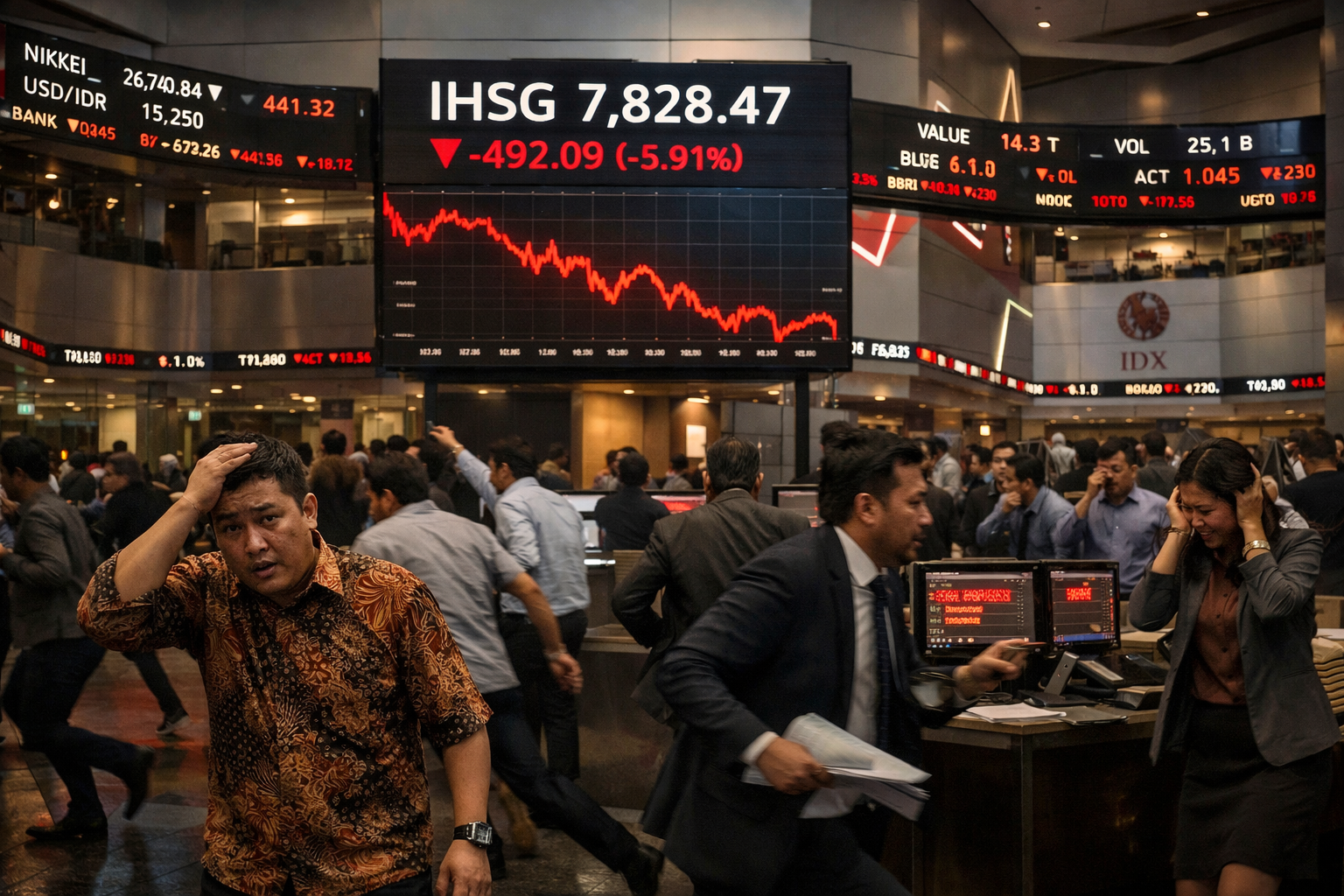
The Indonesian IDX Composite Index (also widely reported as the Jakarta Composite Index or IHSG) collapsed by about −492.09 points, roughly −5.91 % from its peak near 9,000 in just two days—wiping out years of gains. This dramatic turnaround did not happen because of a single cause but rather a convergence of market, structural, economic, and political factors that spooked investors both inside and outside Indonesia.
A Sudden Catalyst: MSCI Investability Warning
The most immediate trigger for the plunge was an announcement from MSCI (Morgan Stanley Capital International), the global index provider whose benchmarks guide trillions of dollars in passive investment funds. On January 28–29, 2026, MSCI flagged serious concerns about the transparency and investability of Indonesian stocks. It said it would freeze certain index changes and halt rebalancing involving Indonesian securities because of opaque shareholding structures and questions about price formation in the market. This surprised many investors and raised the specter of Indonesia being downgraded from an “emerging market” to a “frontier market” classification if the issues were not resolved by May. Such a downgrade would likely result in systematic capital outflows from passive funds that track emerging-market indices, amplifying selling pressure.
Investors treated MSCI’s warning not as a technical footnote but as a harbinger of diminished global allocation to Indonesian equities. The market reacted violently, with the index falling sharply, triggering an automatic trading halt when losses exceeded regulatory thresholds designed to curb panic.
Market Psychology and Panic Selling
Once MSCI’s statement hit trading screens, panic selling took hold, especially among foreign institutional investors. In markets like Indonesia’s, where foreign capital plays a large role, swift withdrawals can exert outsized impact. The sell-off was self-reinforcing: as prices dropped, algorithmic and stop-loss orders amplified the slide, feeding more outflows and deepening losses across sectors.
Although not all losses originated from fundamental economic deterioration, sentiment became deeply negative. This type of momentum-driven decline can cascade quickly in less liquid emerging markets, where large trades often move prices more than they would in major markets.
Structural Vulnerabilities in the Indonesian Market
Several structural issues made the market especially fragile:
1. Transparency and data issues: MSCI’s concerns about the quality of shareholding data and ownership transparency touched a core investor priority. When a major index provider questions data integrity, foreign investors see higher operational risk.
2. Concentrated ownership: Many large Indonesian companies are family-controlled or tightly held. This can limit the free-float shares easily traded by foreign investors and reduce liquidity. Low free float makes it harder for global funds to scale positions in and out without large price impact.
3. Historical sensitivities: Indonesia’s markets have previously reacted violently to shocks like political upheaval and economic uncertainty, as seen in earlier years when heavy selling triggered trading halts. That history can feed investor caution.
Broader Economic and Policy Headwinds
While MSCI’s warning was the flashpoint, it came against a backdrop of economic and policy concerns that had already eroded confidence:
1. Foreign capital outflows: Indonesia had been experiencing sustained foreign investment withdrawals, weakening demand for equities and the rupiah. Persistent outflows left the market more vulnerable to sudden shocks.
2. Fiscal pressure and policy uncertainty: Investors have grown uneasy about fiscal balancing, a widening budget deficit, and the potential for tighter state influence over markets. Some recently controversial appointments and dismissals in finance and central banking circles raised questions about policy consistency and central bank independence.
3. Macro pressures: Beyond equity indices, the rupiah had weakened against the U.S. dollar, and commodity price volatility affected Indonesia’s export earnings. Combined with global sizing up of emerging market risk amid stronger dollar conditions, these factors pressured asset valuations.
Technical Triggers and Automated Market Responses
Modern trading systems enforce circuit breakers and trading halts to prevent disorderly markets. When the IHSG slid beyond predefined thresholds—first 5 % and then 8 %—the Indonesia Stock Exchange temporarily halted trading to allow markets to cool. While these measures are protective, they also signal distress to investors and can accelerate margin calls or forced selling once markets reopen.
What It Means Going Forward
The sudden wipe-out of gains on the IDX Composite Index underscores deep vulnerabilities:
- Confidence has become a critical issue. Without credible steps to enhance transparency, foreign investors may stay on the sidelines, reducing liquidity and upward momentum.
- Policy clarity matters. Markets desperately need consistent, investor-friendly regulatory signals to rebuild trust.
- Structural reforms are essential. Improving data quality, expanding free float, and strengthening corporate governance could help avert future routs.
In summary, the historic slide in the Indonesian stock market was not random. It was a market reaction to a credible threat of reduced global investment eligibility, compounded by ongoing capital outflows, economic pressures, and structural fragilities in the market’s transparency and governance frameworks. Addressing these issues will be key to restoring confidence in Indonesia’s financial markets.
Join the Conversation
Please log in or create an account to view comments and post your own.