
More results
Kuartaly Magazine Issue No. 3 – The Return of Industrial Power

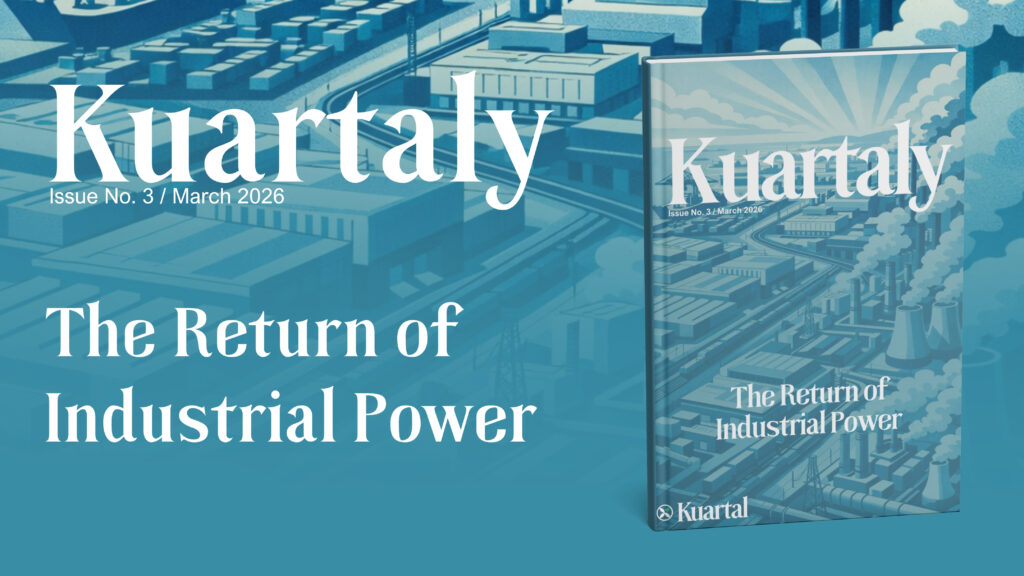
Kuartaly Magazine — Issue No. 3 / March 2026
The third issue of Kuartaly examines one of the most consequential shifts in the global economy: the return of the state as an industrial architect. After three decades in which markets were trusted to allocate capital, determine supply chains, and set the terms of global trade, governments have re-entered the room. They are building factories, subsidising semiconductors, taxing imports, and directing investment with a conviction not seen since the postwar era.
The Return of Industrial Power explores what happens when the world’s major economies decide that industrial capacity is too important to be left to comparative advantage alone. This is not simply a story about tariffs or protectionism. It is a story about how the architecture of global production is being redrawn — and what that means for markets, capital flows, and the countries that must position themselves in a new industrial order.
At the centre of this issue is Indonesia, a nation with vast natural resources, a young workforce, and an ambition to move up the value chain. But the forces shaping industrial strategy reach far beyond Jakarta. From Washington’s semiconductor subsidies to China’s manufacturing overcapacity, from Germany’s industrial contraction to Southeast Asia’s rise as the world’s new factory floor, the contest for industrial power is defining the economic decade.
Inside this issue:
🏭 The Return of Industrial Power: Why the State Is Back in the Factory
A global overview of how governments from Washington to Beijing are reclaiming industrial policy as a core instrument of national strategy — and what it means for markets, trade, and economic competition.
🇮🇩 Indonesia Spotlight: Downstream or Bust — The High-Stakes Bet on Industrial Transformation
Indonesia’s resource nationalism and downstream processing ambitions represent one of the most audacious industrial strategies among emerging economies. We examine whether the country has the institutional capacity, fiscal runway, and investment climate to pull it off.
Regional Spotlights
🇺🇸 United States: The Subsidy State Returns
The CHIPS Act, the Inflation Reduction Act, and a new era of tariff escalation signal a decisive break from the free-market orthodoxy that defined American economic policy for a generation.
🇨🇳 China: The Overcapacity Dilemma
Beijing’s industrial machine is producing more than the world can absorb. The resulting export surge is reshaping global pricing power and provoking a new wave of protectionist responses.
🇩🇪 Germany: Industrial Giant in Structural Retreat
High energy costs, ageing infrastructure, and the loss of the China growth engine are forcing a reckoning with the long-term viability of Europe’s most important industrial economy.
🌏 Southeast Asia: The New Factory Floor
Vietnam, Thailand, Malaysia, and Indonesia are absorbing manufacturing investment fleeing China. But supply chain diversification is not the same as industrial development.
🇮🇳 India: Manufacturing Ambition Meets Structural Friction
New Delhi’s production-linked incentive schemes have attracted headlines and foreign capital. Whether they can overcome India’s infrastructure and regulatory constraints is the harder question.
Sector Analysis
📊 Featured: Indonesia in March — Under Pressure but Not Yet Breaking
A close reading of how Indonesian markets have absorbed a simultaneous currency shock, sovereign outlook downgrades, and post-Eid liquidity dynamics.
⚙️ Heavy Industry: Capital Returns to Steel, Cement, and Chemicals
Global infrastructure spending and supply chain reshoring are restoring pricing power to industries long dismissed as structural losers.
💡 Energy: Industrial Power Needs Cheap Power — and That Is the Problem
The energy intensity of the new industrial policy wave is colliding with the realities of the energy transition, creating dangerous fiscal and environmental trade-offs.
🏦 Banking: Credit Flows Toward Industry — With Familiar Risks
State-directed lending to industrial champions has a long and troubled history. Banks across emerging markets are being asked to fund ambition that markets alone would not finance.
💻 Technology: Semiconductors and the Limits of Strategic Autonomy
Every major economy wants its own chip industry. The economics of semiconductor manufacturing suggest most of them will be disappointed.
🚢 Logistics and Ports: Infrastructure as Industrial Strategy
Control over ports, shipping lanes, and logistics networks is increasingly being treated as a matter of national economic security.
Perspectives
🔩 The Myth of the Manufacturing Revival
Reshoring is real, but the factories returning to developed economies are automated, capital-intensive, and employ far fewer workers than the ones that left. The political promise of industrial jobs deserves harder scrutiny.
🌿 Green Industry or Green Illusion?
Industrial policy is being dressed in the language of the energy transition. In practice, the two agendas are frequently in tension — and honesty about that tension has been scarce.
Capital Markets
📈 Indonesian Equities: The MSCI Overhang and the Cost of Opacity
The threat of a downgrade from emerging market to frontier market status is not merely a technical reclassification — it is a verdict on Indonesia’s investment architecture.
🇺🇸 US Industrial Stocks: Priced for a Renaissance That May Take a Decade
Markets have re-rated defence, infrastructure, and industrial names sharply higher. Whether earnings can justify these valuations is a question still waiting for an answer.
🇸🇦 Gulf Capital and the New Industrial Investment Corridor
Sovereign wealth funds from the Gulf are positioning themselves as the financiers of the new industrial order, deploying capital from Texas to Jakarta.
🌐 Bond Markets and the Fiscal Cost of Industrial Ambition
Industrial policy is expensive. The sovereign bond markets of countries that cannot credibly fund their ambitions are beginning to say so.
📉 Commodities: The Raw Material of the Industrial Comeback
Copper, lithium, nickel, and rare earths sit at the intersection of geopolitics and the industrial renaissance. Supply constraints are structural, and the pricing implications are only beginning to be understood.
Across every story in this issue, one tension recurs: the gap between the ambition of industrial policy and the institutional, fiscal, and economic capacity required to execute it. History suggests that governments that close that gap create lasting competitive advantage. Those that cannot are left with expensive white elephants and crowded-out private investment.
Welcome to Kuartaly Issue No. 3 — a serious look at who is winning the new contest for industrial power, who is falling behind, and what it means for the capital that must find its way through both. 📊🏭
Join the conversation
Log in or create an account to leave a comment.
Log in Create account