
More results
The AI Hype Cycle: Are we in a massive bubble, or is this the new electricity? (Hint: It’s Probably both).

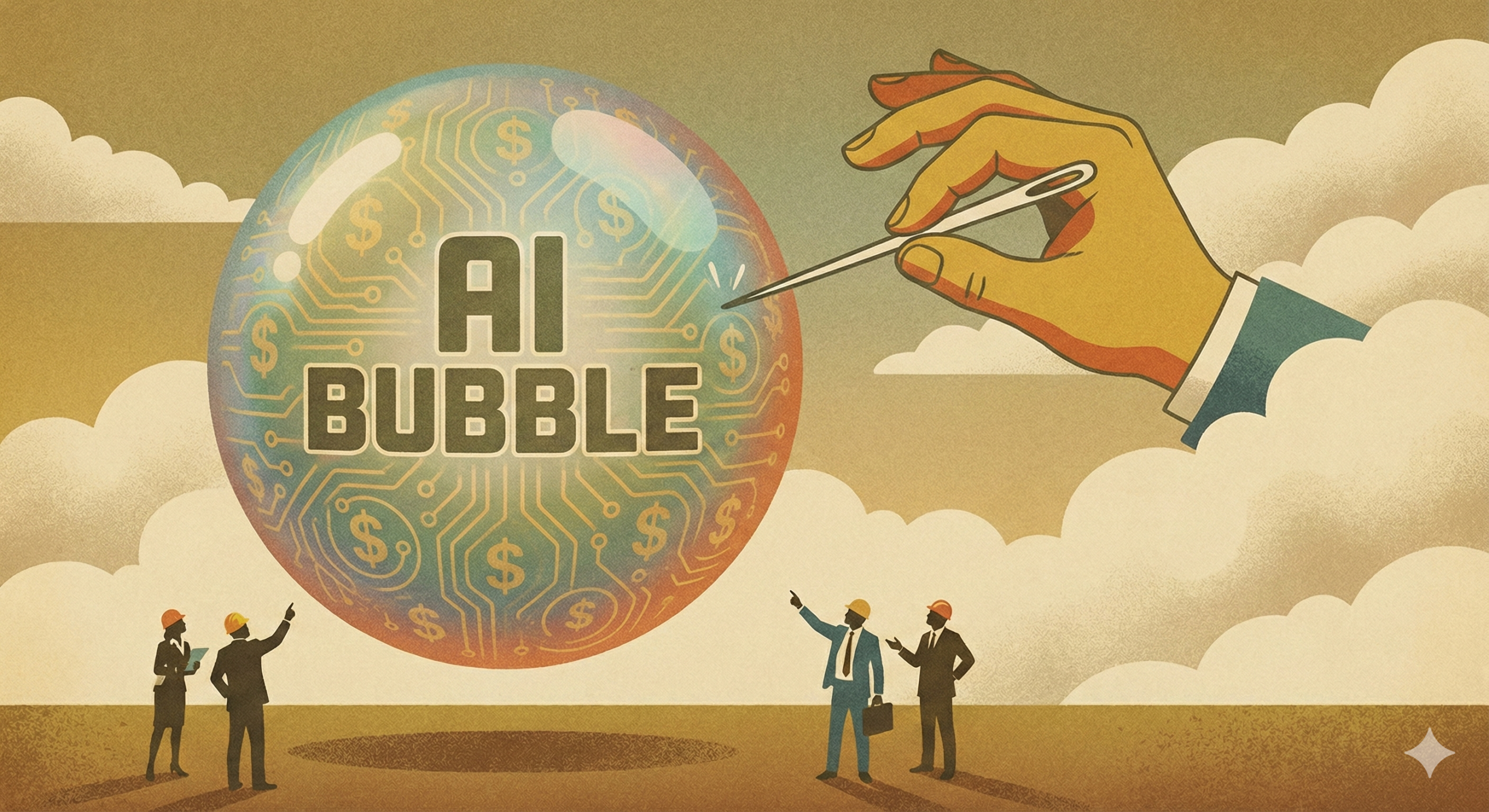
I’ve been watching the current state of “AI” mania with a mix of awe and severe skepticism. While toddler me may not have been conscious during the Dotcom bubble and eight year old me didn’t even understand the concept of money during the 2008 Financial Crisis – looking back at it now what we’re seeing with AI echoes a lot of these moments in history. And depending on which side of Twitter/X or Reddit you reside on, we are either on the verge of Artificial General Intelligence fixing global warming by Thursday, or we are witnessing the biggest capital misallocation since the tulip bulb craze.
Every earning call seems to just be CEOs saying “AI” fifty times to juice up their stock price. VCs are throwing nine-figure valuations at pre-revenue startups founded three weeks ago by tech bros who just pivoted from their previous crypto rug pull.
Though salty I may sound, I do actually want to open up a real discussion here, away from the mindless hype-bro threads and also the pure luddite doomerism.
So the question remains. Is this a bubble?
My personal take: Yes, absolutely. It is massive financial bubble. But that doesn’t necessarily mean that the tech is fake.
We seem to be reenacting the Dotcom boom-and-bust of 1997-2001 nearly beat-for-bloody-beat. But here is my breakdown of why this is definitely a bubble and despite being such it might not matter in the long run.
Firstly, if you look at the financial mechanics and the grift, it looks bad.
95% of the “hot new AI startups” right now are thin UI layers pasted over the OpenAI or Anthropic API – like some kind of “GPT-Wrapper” Epidemic. They have absolutely zero moat, and I am never going to agree with A16Z partners saying that “momentum” is somehow a moat. As soon as ChatGPT releases a minor update, their entire business model evaporates. Does everyone here remember “Jasper”?
Still, Venture Capitalists are terrified of missing out on the next Google. They are funding anything. If your pitch deck says “.ai”, you immediately get a meeting. This leads to massive overvaluation of companies that will never turn a profit.
All the while everyone is ignoring the electricity bill. Running these models remains wildly expensive in 2025. Microsoft and Google can subsidize it for a while to capture market share, but most of these startups have unit economics that are completely upside down. Even the big ones. They are lighting cash on fire hoping to be acquired before the money runs out.
Adding onto that, right now we are also starting to see the first wave of hardware vaporware crash and burn (look at Humane AI Pin and the Rabbit R1). Try as they might, it just turns out that an LLM is not always a better interface than a screen. Who would’ve thunk!
However, if you compare this to the Crypto/Web3 hype cycle of 2021, there is a massive difference: Utility. Unlike the pump-and-dumps of NFTs and Tokens AI has real world applications in multiple fields.
While I remain a skeptic on the valuation and revenue side, I understand the user-end value of it all. I use Gemini, Claude and ChatGPT every single day for coding help, summarizing dense documents, and brainstorming. It provides immediate, tangible value today. Hell, a massive portion of Kuartal exists thanks to AI and we ourselves continue to work hard in finding helpful ways for AI to help our user base.
You can ask any software engineer. GitHub Copilot and Cursor have fundamentally changed how code is being written. This isn’t something that is “maybe useful someday,” it’s something that is “increasing productivity by 30% right now.”
And despite the terrifyingly circular looking loop-de-loop purchase charts – the hundreds of billions being spent by Nvidia, Microsoft, Meta, etc., on each other isn’t just vanishing. They are building actual data center infrastructure. Even if the current software hype crashes, that compute capability still exists. This of course doesn’t account for the money spent on things that degrade over time or immediately becomes unusable or has a short life cycle like the chips or electricity and water bills.
And yet I remain firmly believing that the Dotcom Analogy holds up.
I think the Dotcom crash is the perfect roadmap. Not because of what happened during it – but what happened after it.
In 1999, the internet was clearly the future. But investors got way ahead of reality. We had Pets.com and Webvan burning billions on ideas that were too early or just bad. Businesses that just were not real businesses riding the coat-tails of the internet hype. When the bubble burst, thousands of companies went to zero.
But the internet didn’t go away. The dust eventually began to settle and what remained is what we see today. The mature age of doing business online.
The crash cleared out the garbage. The infrastructure that was built during the boom (fiber optics, server farms) remained. The companies with real business models (Amazon, Google, eBay) emerged from the ashes stronger and actually changed the world.
We are heading for an “AI Winter” (financially speaking) in the next 18 months. Like the tech winter we saw cascading from the Silicon Valley Bank collapse and the rampant cases of startup frauds from FTX to eFishery to Theranos. The GPT-wrappers will die eventually. A lot of VCs will lose their shirts. And the stock market will punish those companies that spent billions on GPUs with no ROI to show for it in the same way the Dotcom bubble punished fake online businesses, the tech winter punished fraudulent founders, and so on and so forth.
But when the smoke clears, the underlying LLM/transformer technology will remain integrated into everything we use, just like the internet is today.
But that’s where I’ll lend my little spiel. I want to know where do you all stand? Are you buying the dip on NVDA forever, or are you waiting for the inevitable crash?
Join the Conversation
Please log in or create an account to view comments and post your own.