
More results

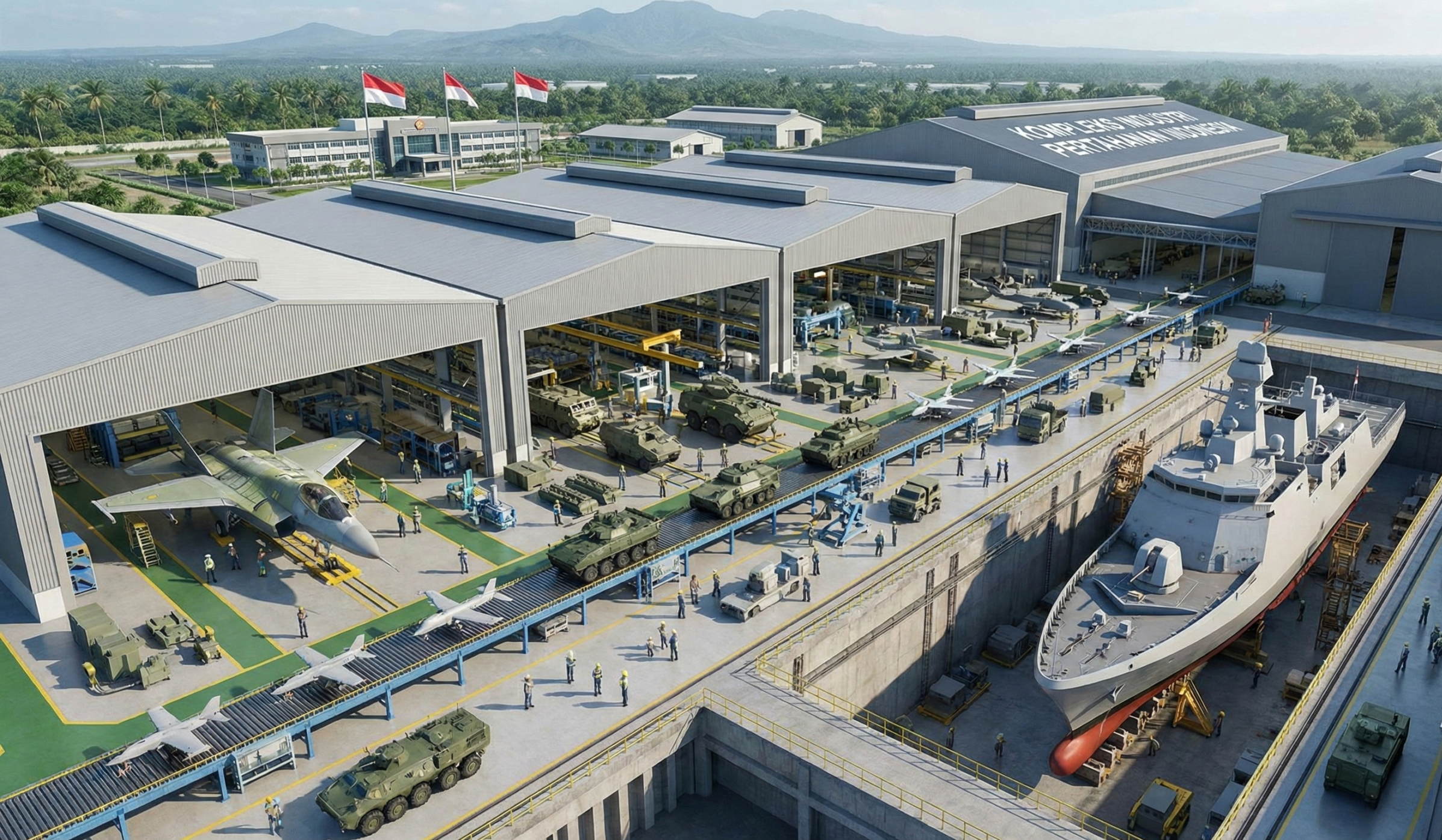
In an era of deepening geopolitical complexity, where military conflicts are becoming both hotter and wider, nations globally are recalibrating their defense postures. The logic of “peace through strength” has returned to the forefront of international relations, driving a massive wave of re-industrialization in the defense sector.
The European Union has launched the European Defence 2030 program, mobilizing €800 billion to overhaul infrastructure and operational readiness. In East Asia, Japan is aggressively upgrading the Japan Self-Defense Forces (JSDF), acquiring Tomahawk missiles and pouring capital into high-tech domestic industries. Indonesia is charting a parallel course. Following his election, President Prabowo Subianto signaled a robust intent to revitalize the domestic defense industry with a singular goal: autarky in the production of primary weapons systems (Alutsista).
While Indonesia has strengthened ties with Turkey, South Korea, Italy, and France, the internal directive is to ramp up domestic production of drones, rocketry, ballistics, missiles, and artillery. However, a critical vulnerability remains: Supply Chain Security.
The 70% Vulnerability Gap
Currently, Indonesia relies on imports for approximately 70% of the raw materials used in its defense industry. This exposure is a critical risk factor. A blockade of the Suez Canal, attacks on cargo in the Red Sea, or an escalation in the South China Sea could sever supply lines, effectively paralyzing the Indonesian defense manufacturing sector due to a lack of feedstock.
To counter this, Indonesia is pivoting toward a strategy of “Natural Hedging”—utilizing its massive mineral wealth not just for economic gain, but for national survival.
The Resource Hedge: Turning Minerals into Munitions
The investment thesis for Indonesia’s defense sector begins in the ground. The country possesses the raw materials required to insulate its defense industry from global sanctions or embargoes. The focus is shifting toward Eastern Indonesia, a hub for strategic minerals that serve as the building blocks of modern warfare.
| Mineral | Defense Application | Strategic Importance |
| Nickel | Armor plating, jet engine turbines (superalloys), warship hulls. | As the military shifts toward lighter, stronger armor and electric tactical vehicles, Nickel is the critical enabler. It allows for the creation of steel alloys that are rust-resistant and capable of withstanding extreme heat. |
| Copper | Avionics, military communication systems, wiring, tank components. | Copper is the nervous system of modern defense. It is non-negotiable for military electronics, radar systems, and the wiring harnesses essential for aerospace applications like the KFX/IFX fighter jet. |
| Brass | Shell casings (small arms & artillery), naval propellers. | An often overlooked but vital alloy. Its high durability and recyclability make it the standard for ammunition casings. Domestic brass production ensures the TNI can sustain prolonged firefights without relying on imported casings. |
The Downstreaming (Hilirisasi) Play
The government’s push for “Hilirisasi” (downstreaming) is evolving from an economic policy into a national security imperative. The government must push beyond basic extraction toward defense metallurgy.
For investors, the opportunity lies in companies moving into high-grade alloy processing rather than just raw ore export. Establishing manufacturing hubs in Eastern Indonesia would not only decentralize logistics—protecting them from a single point of failure—but also lower transport costs and spur local economies.
The Industrial Base: The “Investable” Ecosystem
To capitalize on this shift, we must look at the supply chain ecosystem. While the core defense manufacturers (Defend ID members like PT Pindad and PT PAL) are State-Owned Enterprises (BUMN), the supply chain is populated by publicly listed companies and large private conglomerates that are positioning themselves as essential partners.
The Upstream Giants (IDX Listed Candidates)
These companies control the feedstock. As the government mandates a higher “Domestic Component Level” (TKDN), these miners stand to benefit from long-term government offtake agreements.
PT Aneka Tambang Tbk (ANTM) & PT Vale Indonesia Tbk (INCO)
These are the titans of Nickel. Their relevance extends beyond batteries; they are the primary providers of the raw material needed for high-strength steel alloys used in armored vehicles (like the Anoa or Maung) and naval vessels. As PT PAL ramps up production of frigates and submarines, the demand for domestic, high-grade nickel alloys will skyrocket to meet local content requirements.
PT Amman Mineral Internasional Tbk (AMMN) & PT Merdeka Copper Gold Tbk (MDKA)
Copper and Gold are essential for the digitization of the TNI. Modern warfare is network-centric, requiring massive amounts of copper for data transmission and power delivery. AMMN and MDKA are well-positioned to supply the refined copper cathodes needed for domestic avionics and radar manufacturing.
PT Timah Tbk (TINS)
Tin is the unsung hero of electronics. TINS provides the solder required for every circuit board in a missile guidance system or radio unit. Furthermore, tin is a key component in bronze and specific brass alloys used in naval propellers and heavy munition casings.
The Industrial & Manufacturing Enablers
These companies possess the engineering capacity to pivot into defense contracting or dual-use technology.
Astra International Tbk (ASII) – via United Tractors (UNTR)
United Tractors is a giant in heavy machinery and construction. While currently focused on mining and civil infrastructure, their engineering capacity is perfectly suited for heavy vehicle maintenance and assembly. In a wartime scenario or rapid industrial ramp-up, UNTR’s facilities could arguably be repurposed to assemble chassis for tactical trucks or engineering vehicles (Zeni), acting as a force multiplier for PT Pindad.
PT Dharma Polimetal Tbk (DRMA)
A leader in automotive components and precision manufacturing, DRMA is an ideal candidate for the “tier 2” supply chain. Their expertise in metal stamping and suspension systems is directly applicable to the defense sector. They could easily pivot to manufacturing precision parts for weaponry, suspension systems for tactical vehicles, or stamped metal bodies for mass-produced drones.
Indika Energy Tbk (INDY)
Through its subsidiary ALVA, Indika is aggressive in the electric mobility space. The military application here is the electric tactical motorcycle. Electric bikes are silent and have a low heat signature, making them perfect for reconnaissance and special forces operations. ALVA’s manufacturing capability could be adapted to produce ruggedized, military-spec electric bikes for the TNI.
The Private Champions: Beyond the State
While State-Owned Enterprises (BUMN) get the headlines, a robust layer of private defense companies has emerged in Indonesia, driving innovation and efficiency.
PT Komodo Armament Indonesia
This is perhaps the most significant private player in the small arms sector. Unlike PT Pindad, which is state-run, Komodo Armament is a private entity that manufactures assault rifles (like the D5 and D7), sniper rifles, and significantly, propellants and ammunition. Their ability to produce NATO-standard weaponry domestically provides the TNI with a vital “second source” of arms, reducing reliance on a single state provider.
PT Sari Bahari
Based in Malang, PT Sari Bahari has carved out a niche in aerial munitions. They manufacture practice bombs (P-100 to P-500 series) and rocket launchers for the Indonesian Air Force (TNI AU). Impressively, they have successfully exported their products to Vietnam, proving that Indonesian private defense tech is competitive on the global stage. They are a prime example of how private specialized labs can outperform generalist state giants.
PT Infoglobal Teknologi Semesta
If Pindad builds the “body” of the machine, Infoglobal builds the “brain.” They specialize in avionics, radar data processing, and mission computers. They have successfully retrofitted avionics for the TNI’s Hawk 100/200 and C-130 Hercules aircraft. As Indonesia looks to extend the life of its existing air fleet while waiting for new Rafales, Infoglobal’s role in modernization and retrofitting is indispensable.
The Startup Frontier: Defense Tech & “New Space”
The future of defense is not just heavy metal; it is software, AI, and cheap, expendable hardware. This is where the startup ecosystem can disrupt the market.
Unmanned Systems (UAV/USV)
The war in Ukraine has demonstrated that quantity has a quality of its own. Indonesia needs affordable, mass-producible drones. Startups like Terra Drone Indonesia or Bentara Tabang Nusantara (Beta) are well-positioned to pivot from industrial mapping to ISR (Intelligence, Surveillance, Reconnaissance) roles. The gap in the market is for “Loitering Munitions” (suicide drones)—a vertical that a nimble startup could capture faster than a slow-moving BUMN.
Defense Cybersecurity & AI
Modern warfare is cyber-centric. Startups currently focusing on “Smart City” analytics (like Nodeflux or Qlue) possess the underlying technology for military application. The same AI that counts cars in Jakarta can be retrained for facial recognition at border crossings or threat detection in maritime surveillance feeds.
Advanced Materials
There is a massive opportunity for chemical engineering startups to focus on Ammonium Nitrate (for explosives) or niche metallurgy labs focusing on lightweight composite armor. Reducing the reliance on imported propellants is a high-priority national security goal.
Governance: The Key to Unlocking Value
None of this potential can be realized without a shift in governance. The original analysis suggests two paths for the Indonesian government:
1. The Conservative Path (Reform Ditjen Pothan)
This involves streamlining the existing Directorate General of Defense Potential within the Ministry of Defense. The goal would be to make it more business-friendly, speeding up the certification process for private companies and simplifying procurement rules. This is the path of least resistance but offers slower results.
2. The Experimental Path (The “Turkish Model”)
This is the high-reward option. It involves creating a powerful, independent agency similar to Turkey’s SSB (Presidency of Defense Industries).
- Why it matters: An independent agency removes procurement from the slow bureaucracy of the military and the ministry. It can act like a venture capitalist, funding R&D, managing long-term contracts, and aggressively pushing for exports.
- The Result: Turkey went from 20% domestic production to nearly 80% in two decades using this model. If Indonesia adopts this, it would signal a massive “Buy” signal for investors in the sector.
Conclusion
Indonesia is standing at the precipice of a defense industrial revolution. The combination of geopolitical necessity, abundant natural resources, and a growing private industrial base creates a unique investment landscape. For the savvy observer, the signal is clear: the transition from “spending” on defense to “investing” in defense capability is underway.
Join the Conversation
Please log in or create an account to view comments and post your own.