
More results
From the Battlefield to the Smelter: The Efficiency Case for Industrial Sustainability

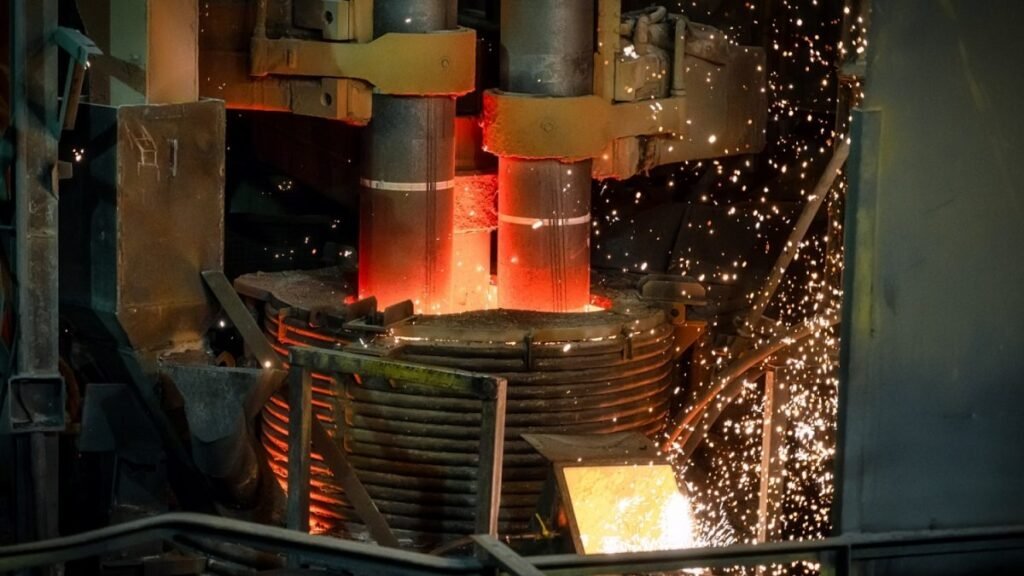
Since the European Union’s carbon border charge went fully live on 1 January 2026, taxing imported steel, cement, aluminium, and several other heavy-industrial goods for the carbon emitted in making them, the sustainability conversation inside heavy industry has quietly shifted register. What used to be argued mostly on ethical grounds is now being argued, and increasingly won, on competitiveness grounds: that a firm’s exposure to carbon costs, volatile fuel prices, and environmental liability is itself a business risk, and that reducing it looks a lot more like an efficiency upgrade than an act of charity. Nowhere is that argument sharper than in heavy manufacturing and the defence-industrial base sitting on top of it, sectors responsible for close to a quarter of global carbon dioxide emissions that cannot simply wish away the raw-material and energy intensity that defines them.
Take steel. In 2021 the Swedish joint venture HYBRIT, backed by steelmaker SSAB, miner LKAB, and utility Vattenfall, delivered the world’s first fossil-free steel to a commercial buyer, Volvo, using hydrogen instead of coking coal to strip the oxygen out of iron ore. At industrial scale, the technology could cut Sweden’s entire national carbon output by roughly ten percent. What matters commercially is not the emissions arithmetic alone but the fact that a decade of patient, state-backed investment produced a product a major manufacturer actually wanted to buy: clean steel and premium steel turned out to be the same steel.
Defence planners arrived at a parallel conclusion by a much harder route. A widely cited Army study of the Iraq and Afghanistan campaigns found that US forces suffered roughly one casualty for every 24 fuel-resupply convoys run in Afghanistan, and about one for every 39 in Iraq, a direct, countable link between how much fuel a force burns and how many of its own people get hurt moving it. That finding is a large part of why NATO, an alliance built on hard security rather than climate policy, has since committed formally to mapping and cutting greenhouse gas emissions from its own military activities and installations. Fuel efficiency here is not a green add-on to combat power. It is combat power, expressed as fewer convoys, fewer targets, and more reach.
The harder question is how a state makes sustainability pay off without simply handing market share to less-regulated rivals. The logic is not new: Japan’s worst-polluting industries of the 1960s, chemicals and petrochemicals prominent among them, were forced by a blunt set of laws passed after the country’s worst pollution disasters to internalise costs they had spent two decades avoiding, and the two decades after that made them some of the most energy-efficient manufacturers on earth. The European Union is now trying to engineer that same outcome by design rather than by disaster. Its carbon border charge prices imports at roughly what EU producers already pay under the bloc’s own carbon market, so raising the domestic bar cannot simply be walked around at the border.
Indonesia’s own nickel boom shows what happens when that second half of the equation goes missing. The country’s downstream nickel push, or hilirisasi, has been built substantially on captive coal, off-grid power plants built solely to run smelters, with total capacity that a recent industry analysis projects could reach 31 gigawatts, more than Australia’s entire coal fleet. The same analysis found that a typical nickel hub’s profits peak around year five before being eaten away by environmental and social costs by year eight, and in December 2025 a district court in Poso, Central Sulawesi, found nickel operators liable for unlawful environmental destruction. Downstreaming raw nickel into higher-value exports makes real strategic sense. But power decisions made for the sake of speed now are already turning into liabilities for the industry that has to live with them later, and if Jakarta wants processing capacity that outlasts the investment cycle that built it, the coal question cannot stay a footnote to the pitch deck.
Join the conversation
Log in or create an account to leave a comment.
Log in Create account