
More results

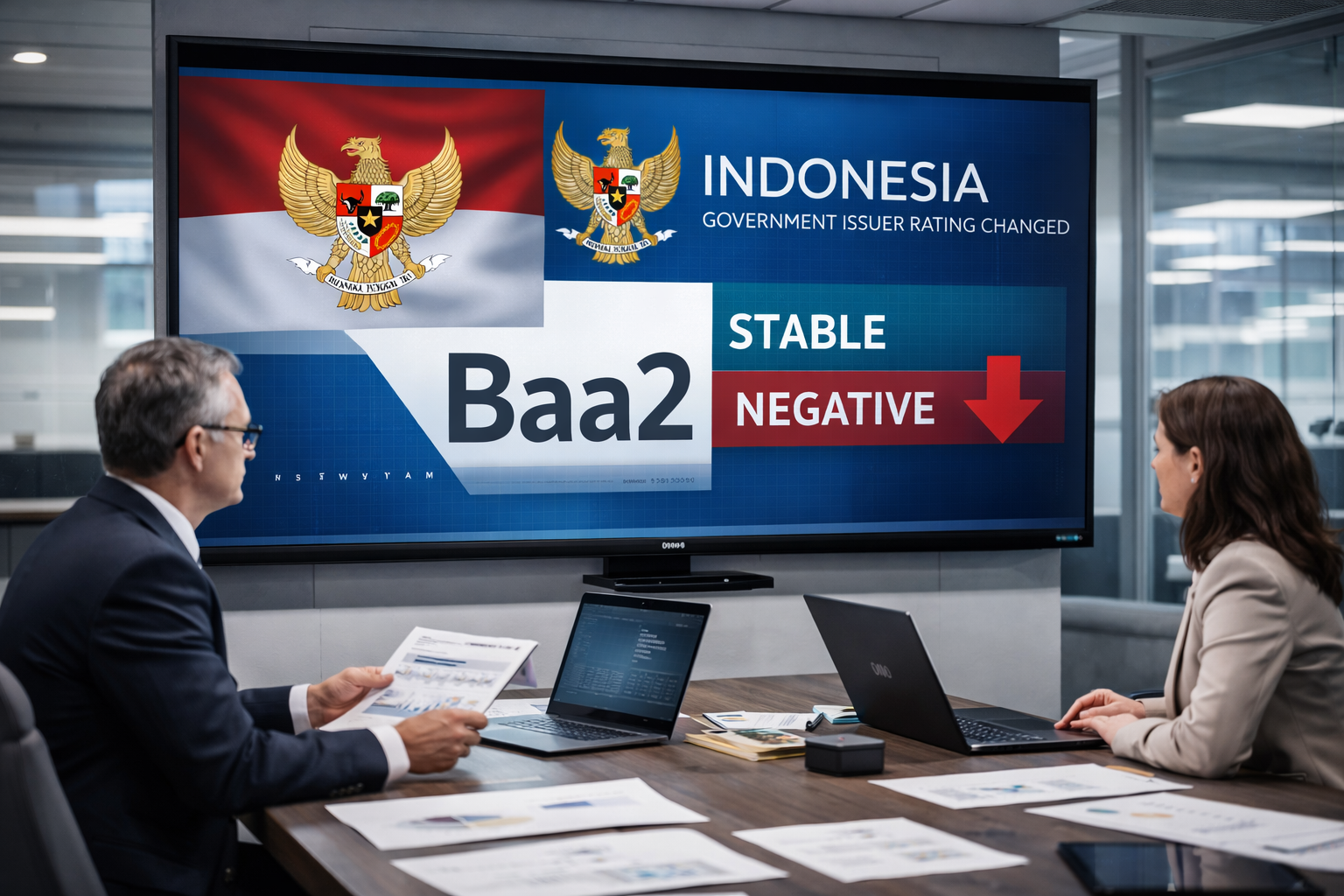
In a move that has reverberated through Indonesia’s financial landscape, Moody’s Ratings has revised the outlook on the Government of Indonesia’s issuer rating from Stable to Negative, while affirming the country’s long-term sovereign credit rating at Baa2. The announcement, made on Thursday, marks a significant shift in sentiment from one of the world’s “Big Three” credit rating agencies, serving as a stark warning regarding the country’s shifting fiscal landscape and the perceived reduction in policy predictability under the current administration.
The decision was not precipitated by a sudden collapse in economic fundamentals—Indonesia’s GDP growth remains robust at over 5%—but rather by institutional anxieties. Moody’s explicitly cited “reduced predictability and coherence in policymaking” as the primary driver for the negative outlook. Central to these concerns is the newly established sovereign wealth fund, Danantara. With authority over approximately $900 billion in state assets, representing roughly 60% of Indonesia’s GDP, the agency flagged significant uncertainty regarding the fund’s governance, financing structure, and investment priorities. The transfer of such massive assets without a clearly communicated framework risks undermining policy effectiveness and blurring the critical lines between state budget obligations and commercial investment.
Compounding these structural concerns are the government’s ambitious new social programs, most notably the Free Nutritious Meal (MBG) initiative and the massive People’s Housing project. Moody’s warned that funding these programs through budget cuts and reallocations creates a high fiscal risk, particularly given Indonesia’s historically low tax-to-GDP ratio. While the government has vowed to keep the budget deficit under the legal limit of 3% of GDP, the agency noted that the pressure to deliver on these populist promises could severely test that ceiling. Furthermore, the report highlighted that recent policy shifts have been communicated poorly, contributing to weakening governance indicators that follow closely on the heels of MSCI’s recent decision to flag Indonesian securities for investability issues.
The market reaction to the news was immediate and punishing. The Jakarta Composite Index (IHSG) tumbled nearly 5% over the course of the week, closing at 7,935.26, while the Rupiah depreciated to approximately Rp16,880 per USD, its weakest level since late January. The negative sentiment was not limited to sovereign debt; following the sovereign outlook cut, Moody’s also revised the outlooks to Negative for the “Big 4” banks—BCA, Bank Mandiri, BNI, and BRI—as well as major state firms like Telkom Indonesia, Pertamina, and mining giant MIND ID.
Government officials moved quickly to calm the markets, describing the rating agency’s view as a misunderstanding of the country’s new economic architecture. Coordinating Minister for Economic Affairs Airlangga Hartarto defended the administration’s strategy, stating that global financial markets do not yet fully understand the new growth strategy. He argued that Danantara is designed to separate commercial investment from the state budget, which would actually improve the health of the APBN. Similarly, Bank Indonesia Governor Perry Warjiyo emphasized that Indonesia’s economic fundamentals remain solid, with 2025 GDP growth of 5.1% outpacing most G20 peers and inflation remaining well-controlled.
Economists generally view this move as a “warning shot” rather than a signal of an immediate crisis. A Negative Outlook typically indicates a one-in-three chance of a rating downgrade over the next 12 to 18 months. The path forward depends heavily on how the government navigates the coming months; if they can clarify Danantara’s structure and prove they can fund the MBG program without breaking the 3% deficit cap, Moody’s could return the outlook to Stable. However, if fiscal discipline slips or policy confusion continues, Indonesia risks losing its hard-won Baa2 status, which would inevitably raise borrowing costs for both the government and the corporate sector.
Join the Conversation
Please log in or create an account to view comments and post your own.