
More results
The new Indonesia-US Trade Deal is going to be a massive trap for workers and business owners who will pay the price

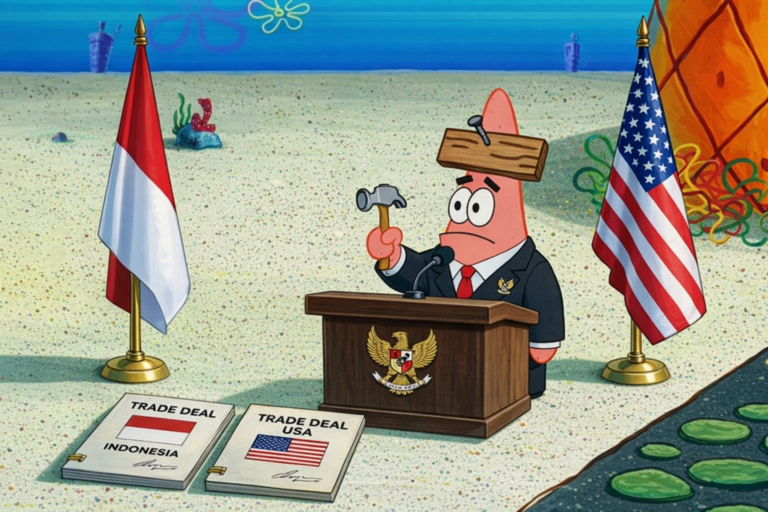
As someone who is managing a sizable portfolio closely monitoring Southeast Asian emerging markets, I’ve been reviewing the structural implications of the recently signed Agreement on Reciprocal Trade (ART) between Indonesia and the United States. While political back-patting is in full swing, a cold, hard look at the macroeconomic realities reveals a highly lopsided arrangement.
If you are allocating capital in Indonesian industrials, renewables, or export-heavy sectors, you need to factor in what is essentially a structural trap. We are sacrificing critical domestic policy space for access that the US is actively walling off.
Here is the breakdown of why this deal—and the immediate US policy responses following it—creates a severe net negative for the Indonesian economy.
1. The Tariff Asymmetry: 0% vs. 10%
Under the ART, Indonesia has committed to granting duty-free (0%) access to 1,819 US tariff lines, essentially opening the floodgates for American agricultural goods, electronic components, and machinery.
We made these concessions under the threat of a 19% to 32% reciprocal tariff. However, following the recent US Supreme Court ruling that struck down the prior administration’s global tariff policy, that original threat evaporated. Yet, rather than reverting to baseline free trade, Washington immediately invoked Section 122 of the 1974 Trade Act to implement a temporary 10% global import tariff (with plans to hike it to 15%).
The Result: We are giving the US zero-percent access to our domestic market, while our non-exempt goods are still forced to navigate a 10% tariff wall just to compete in theirs. From a pure trade-balance perspective, this margin compression actively damages our export price competitiveness while inviting cheap US imports that threaten local SMEs and downstreaming efforts.
2. The Solar Panel Decimation
The most glaring hypocrisy of this “free trade” arrangement is currently playing out in the renewable energy sector. At the exact moment Indonesia is attempting to scale its domestic solar manufacturing to support its ambitious 100 GW green energy transition, the US Commerce Department has decided to effectively nuke our solar exports.
Last week, the US announced massive preliminary countervailing duties (CVD) on Indonesian solar cells and panels, using “anti-subsidy” claims as a shield for domestic protectionism.
- The Baseline Duty: A staggering 104.38% general subsidy rate applied to Indonesian imports.
- Targeted Corporate Hits: Specific manufacturers are facing even worse penalties, with companies like PT Blue Sky Solar hit with a crippling 143.3% duty, and PT REC Solar Energy at nearly 86%.
You cannot scale a high-capex industry like solar panel manufacturing without a robust export market to fund early-stage growth. By slamming the door shut with 140%+ tariffs, the US is intentionally stunting Indonesia’s renewable manufacturing capabilities while demanding unfettered access to our consumer base.
3. Investment Implications & Portfolio Positioning
From an asset allocation standpoint, this dynamic forces a significant recalibration of Indonesian risk premiums:
- Downweighting Export-Heavy Renewables: The US market is essentially dead money for Indonesian solar exporters until at least the final Commerce Department rulings in July 2026. Any domestic manufacturer relying on US export revenues to service debt or fund capex expansion needs to be heavily discounted.
- Vulnerability in Labor-Intensive Sectors: The textile and garment industries remain highly exposed. If the 10% Section 122 surcharge overlaps with standard Most Favored Nation (MFN) rates, our local producers will face compounding margin pressures.
- Trade Deficit Risks: Opening 99% of our tariff lines to US imports without reciprocal frictionless access threatens to widen our current account deficit, potentially adding structural weakness to the Rupiah (IDR) in the medium term.
What The Bottom Line Is
A trade deal is only as valuable as the certainty it provides. The ART operates in an elastic, executive-driven US legal environment where Washington can arbitrarily weaponize the Commerce Department against our most promising high-value exports the second they become globally competitive. We surrendered major leverage for a deal that currently looks like a one-way street.
I would love to hear from other macro analysts or sector specialists on this board. Are you pricing these tariff headwinds into your models for Indonesian equities, or do you see a silver lining in the domestic consumption data that offsets these export shocks?
Join the Conversation
Please log in or create an account to view comments and post your own.