
More results
Wired Wings: What Heart Aerospace’s X1 Means for Indonesia’s Missing Air Bridge

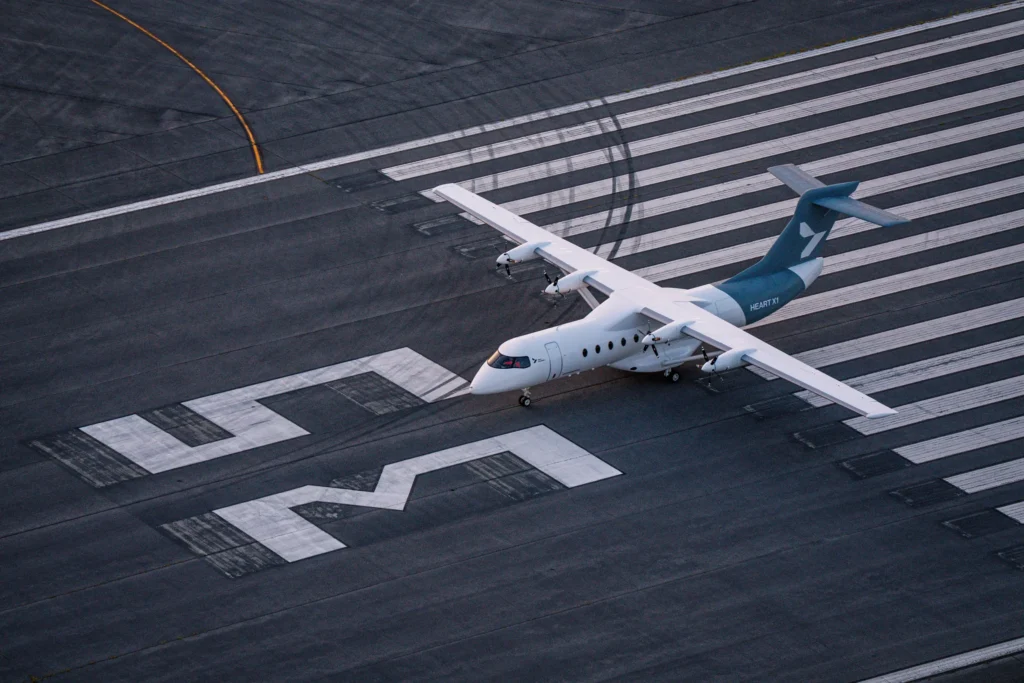
On August 12th, at a regional airfield in upstate New York normally known for little beyond its proximity to the Canadian border, a 25,000-pound aircraft with a 106-foot wingspan lifted off the runway at Plattsburgh International Airport and stayed aloft for 27 minutes on nothing but batteries. Heart Aerospace’s X1 demonstrator, built to the scale of the company’s forthcoming 30-seat ES-30 airliner, became the largest all-electric aircraft ever flown, reaching 1,100 feet and drawing more than a megawatt of power from its motors while burning, by the company’s own accounting, roughly five dollars’ worth of electricity. For an industry accustomed to measuring propulsion cost in tonnes of jet fuel, that number is less a curiosity than a provocation. It suggests, for the first time at commercially relevant scale, that the marginal cost of moving a regional aircraft through the air could fall by an order of magnitude within a single generation of aircraft design.
The test flight itself changes nothing operationally. X1 is a demonstrator, not a certified product, and Heart’s actual production aircraft, the hybrid-electric ES-30, is not scheduled to begin its own flight-test campaign until 2028, with commercial entry into service targeted for 2031. United Airlines, through its regional partner Mesa, has already committed to 100 aircraft with 50 options; Air Canada has ordered 30; JSX has signed on as a launch customer. But the significance of the flight lies less in what it delivers today than in what it proves is physically possible: that an aircraft heavy enough to carry paying passengers over meaningful distances can be flown, taxied, climbed, and landed entirely on stored electrical energy. For a country built from more than seventeen thousand islands, where the economics of connecting small, scattered populations by air have never worked, that proof of concept deserves more attention in Jakarta than it has so far received.
Structural Background: The Archipelago’s Unsolved Connectivity Problem
Indonesia’s aviation economics have always been distorted by geography in a way few other countries experience. Unlike continental markets, where rail, road, and air compete along overlapping corridors, much of Indonesia’s interior connectivity has no substitute for aviation at all. Aircraft are not a faster alternative to a four-hour drive; in provinces such as Papua, Maluku, and parts of Kalimantan and Nusa Tenggara, they are frequently the only means of reaching a hospital, a market, or a functioning school beyond a certain radius. The government has long recognized this reality through its Perintis, or “Pioneer,” route subsidy program, under which turboprop operators such as Susi Air fly loss-making routes into rugged, thinly populated terrain in exchange for public payment. That these subsidies persist year after year, rather than shrinking as the market matures, is itself evidence that conventional aviation economics do not clear on their own in the outer islands.
The reason is structural, not merely a matter of insufficient demand. A conventional turboprop or regional jet carries fixed costs, principally fuel and maintenance, that scale poorly against short stage lengths and thin passenger loads. Jet fuel priced in dollars and shipped to remote airstrips carries a logistics premium on top of the global benchmark; Pertamina’s own pricing data show aviation fuel costs at Soekarno-Hatta nearly doubling between March and April of this year alone, a volatility that airlines serving marginal routes cannot easily absorb. Add engine overhaul cycles measured in flight hours, and the per-seat economics of a fifty-minute hop between two small islands become brutal. Historically, only two responses have existed: subsidize the route indefinitely, as Perintis does, or simply leave the island unconnected and dependent on ferries that can take the better part of a day and are frequently suspended in rough seas. Electric and hybrid-electric propulsion is the first technology in decades to suggest a third option — routes that could clear commercially on genuinely short stage lengths without permanent public subsidy.
The Economic Mechanism: Why Batteries Change the Unit Economics of Short-Haul Flight
The mechanism through which electric propulsion reshapes regional aviation economics is straightforward in principle even if formidably difficult in engineering practice. A conventional turboprop’s operating cost is dominated by two variable inputs: fuel burn, which scales directly with distance and payload, and maintenance on a mechanically complex turbine engine with thousands of moving parts operating at extreme temperatures. Electric propulsion replaces both with a comparatively simple motor, drawing power from a battery pack that is expensive to buy but cheap to run and mechanically far less demanding to maintain. Heart Aerospace has stated publicly that it expects the ES-30 to cut operating costs by more than 40 percent relative to legacy regional turboprops, a figure the company attributes to lower energy costs, reduced maintenance from a simplified propulsion architecture, and higher aircraft utilization enabled by integrated electronic systems that reduce turnaround time between flights.
The catch, and the reason Heart’s aircraft is described as hybrid-electric rather than purely electric, is range. Battery energy density remains roughly two orders of magnitude below that of jet fuel by weight, which means an aircraft that can fly on batteries alone for meaningful distances must either accept a punishing weight penalty or accept a short range. Heart’s design compromise pairs an electric powertrain for takeoff and climb, the most energy-intensive phases of flight, with a turbogenerator that extends range for cruise and reserve requirements, targeting stage lengths in the 200-kilometer class fully electric and longer distances in hybrid mode. This is precisely the profile that matches Indonesia’s inter-island geography far better than it matches, say, transcontinental American or European routes. The distance from Denpasar to Lombok is roughly 100 kilometers; from Ambon to the Banda Islands, under 150. Where Western regional carriers see hybrid-electric aircraft as a decarbonization bridge for routes they already fly conventionally, Indonesia’s opportunity is structurally different: these are stage lengths where a fully battery-relevant aircraft class could plausibly open routes that have never existed commercially at all, because no existing aircraft class has ever made them pencil out.
Market and Capital Flow Implications
None of this is imminent capital-markets news; Heart Aerospace remains a private company backed by venture and strategic investors including United Airlines Ventures and Air Canada, and its ES-30 will not enter revenue service before 2031 at the earliest. But the flight matters for how capital is likely to position itself over the coming half-decade across three distinct channels. The first is direct: regional carriers and lessors globally are watching X1’s flight-test data closely as evidence that battery-electric propulsion at commercial scale is de-risking faster than expected, which typically precedes a wave of conditional order commitments from airlines seeking to lock in delivery slots and, more importantly, seeking positioning ahead of tightening emissions regulation in Europe and North America. Indonesian carriers have made no such commitments and are unlikely to for several years, but the capital discipline required to eventually place an order — balance-sheet strength, fleet-planning sophistication, access to aircraft financing — will increasingly separate carriers capable of participating in this transition from those that remain permanently dependent on Perintis-style subsidy.
The second and more immediate channel runs through Indonesia’s battery and critical-minerals complex. Indonesia controls roughly half of global nickel reserves and has spent the past decade building a downstream battery-materials industry anchored around companies such as PT Vale Indonesia, Antam, and the state’s battery holding company IBC, largely in service of the electric-vehicle supply chain. Aviation-grade battery cells demand different specifications from automotive cells, principally far higher energy density and more aggressive thermal and safety margins, so Indonesia’s existing nickel-sulphate and precursor capacity is not a direct substitute. But the raw-material base and the government’s demonstrated willingness to use export controls and downstream-processing mandates to force value capture, as it did with nickel ore beginning in 2020, gives Jakarta a plausible policy lever should aviation-grade battery demand scale meaningfully by the early 2030s. The third channel is fiscal: an Indonesian aviation sector less dependent on imported jet fuel and diesel-fired Perintis subsidies would reduce a persistent drain on the state budget, at a moment when the government has already committed billions of rupiah in VAT relief and fuel-price support just to keep the existing subsidized network running.
Winners and Losers of the new Aviation Duopoly Race and the super short-haul model
The most direct beneficiaries of a maturing hybrid-electric aircraft category are Indonesia’s smaller-format carriers and prospective new entrants built around thin, short-haul networks — operators occupying the space between full-service national carriers and the turboprop pioneers currently running loss-making Perintis routes. A carrier able to acquire hybrid-electric aircraft in the early 2030s at Heart’s projected cost structure would be positioned to serve island-to-island routes that are currently either unserved or dependent on permanent subsidy, potentially converting a public liability into a commercially viable network. Tourism-dependent regional economies stand to benefit disproportionately: destinations such as Labuan Bajo, the Bandas, or the smaller islands of Nusa Tenggara currently rely on a combination of expensive charter flights and slow ferries, a connectivity gap that caps visitor volumes and depresses land values relative to their tourism potential. Airport operators in secondary cities, and by extension the state-owned Angkasa Pura group managing much of that infrastructure, would see utilization rise on runways currently underused outside peak season.
The pressure falls elsewhere. Ferry and ro-ro shipping operators serving short inter-island routes face a genuine long-run competitive threat if air travel becomes price-competitive on stage lengths under 150 kilometers, a dynamic already visible in markets such as Norway and Scotland where short-hop ferry networks have lost share to subsidized regional air links. Incumbent turboprop lessors and maintenance providers built around conventional engines face a slower but real erosion of their addressable market as hybrid-electric alternatives mature, though the long lead times involved mean this pressure will play out over a decade rather than a budget cycle. And the Ministry of Finance itself faces an uncomfortable interim dynamic: any transition to a new aircraft category requires upfront capital and infrastructure investment, including electric charging or battery-swap ground infrastructure at regional airports, before the offsetting subsidy savings materialize, meaning the fiscal payoff sits on the other side of an investment trough that will need to be financed somehow, whether through state development banks, multilateral climate finance, or private concession structures.
How this goes hand in hand with Net Zero 2050 and Indonesia’s role in the EV Industry
Beyond the direct aviation and battery-supply-chain implications, a credible path toward economically viable short-haul electric air links carries second-order consequences that touch regional development policy, land economics, and Indonesia’s broader climate diplomacy. Improved connectivity to secondary islands has historically been one of the more reliable predictors of tourism-driven land-value appreciation, and a genuine reduction in the cost of reaching, say, the Togean Islands or interior Papua could accelerate a pattern of speculative development that Indonesian regulators have struggled to manage well in Bali and Lombok, raising questions about zoning and environmental capacity long before the first hybrid-electric aircraft actually lands. There is also a labor-market dimension: expanded short-haul networks typically increase demand for aviation maintenance technicians, ground-handling staff, and hospitality workers in secondary cities, offering a plausible channel for decentralizing employment growth away from Java, a long-standing objective of Indonesian regional policy that has proven difficult to achieve through infrastructure spending alone.
On the climate and diplomatic side, Indonesia has positioned itself internationally as both a critical-minerals supplier to the global energy transition and, more contentiously, as a country whose downstream nickel-processing industry carries a significant carbon footprint of its own, given its heavy reliance on captive coal power. A domestic narrative in which Indonesian nickel eventually flows into aviation batteries that displace fossil aviation fuel on Indonesian soil would materially strengthen the government’s positioning in future COP negotiations and in bilateral discussions with the European Union over the carbon intensity of its nickel exports, a live point of friction given the EU’s Carbon Border Adjustment Mechanism. None of this is close to certain, and the timeline involved, likely into the 2030s before any of it shows up in hard data, means these remain second-order possibilities rather than near-term catalysts. But strategists building multi-year theses around Indonesian infrastructure, tourism, and critical-minerals equities would be wrong to treat X1’s first flight as irrelevant simply because it happened eleven thousand kilometers away in upstate New York.
Strategic Outlook
For investors and policymakers tracking this space, the near-term signal to watch is not Indonesian order activity, which remains years away, but the pace and specificity of Heart Aerospace’s own certification progress with the FAA and EASA, since regulatory approval timelines are the single largest source of execution risk in any electric-aviation program and have derailed comparably ambitious efforts before. Equally worth monitoring is whether Indonesia’s Ministry of Transportation begins signaling interest in hybrid-electric aircraft within its long-term Perintis and regional-connectivity planning documents, which would indicate the government sees the technology as a genuine substitute for permanent subsidy rather than a speculative curiosity; no such signal currently exists. On the industrial-policy side, any move by Jakarta to explicitly court aviation-battery investment, whether through IBC or a dedicated incentive scheme layered on top of existing EV-battery policy, would mark the clearest evidence that officials are thinking about this opportunity in strategic rather than merely aspirational terms.
The more likely path, in the base case, is that Indonesia remains a spectator to the early years of this transition, watching North American and European carriers absorb the first generation of hybrid-electric aircraft while domestic Perintis subsidies continue largely unchanged through the early 2030s. What would change that trajectory is a combination of falling aircraft acquisition costs as production scales, continued volatility in imported jet-fuel pricing of the kind already straining the 2026 budget, and a domestic carrier or state-linked investor willing to place an early, non-consensus order well ahead of proven commercial viability, in the way Southwest’s early Boeing 737 commitments or AirAsia’s early Airbus A320 orders once reshaped their respective markets. Until one of those catalysts appears, Heart Aerospace’s 27 minutes over Plattsburgh should be read by Indonesian readers not as an imminent solution to the archipelago’s connectivity problem, but as the first hard evidence that a solution to it may, within a decade, actually exist.
Join the conversation
Log in or create an account to leave a comment.
Log in Create account