As wrongful corruption convictions mount and payment arrears stretch into years, Indonesia’s B2G and BUMN contracting environment has crossed a threshold that private capital cannot ignore.
Both MBG and KDMP reflect an ambitious vision of state-led development. They attempt to address social welfare, employment, rural development, and food security simultaneously. The challenge is how to implement them in ways that strengthen communities rather than unintentionally creating new forms of dependency or financial vulnerability.
When Prabowo Subianto campaigned on the promise of transforming Indonesia into a high-growth economic power, the philosophy was clear. The state would not regulate the economy, but it would lead it. Yet Indonesia’s experiment with this model is raising uncomfortable questions. Instead of producing an ecosystem where the state catalyzes private innovation, critics argue that it risks drifting toward something far less productive: a system where political proximity determines access to capital, state programs crowd out private initiative, and a small circle of elites captures the benefits of public spending.
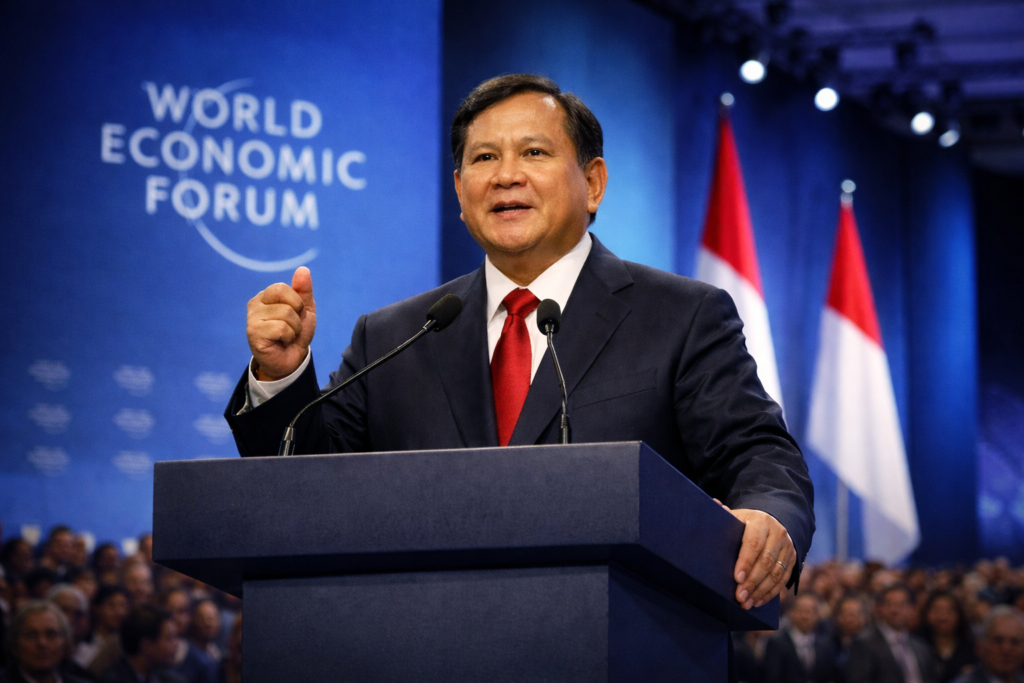
On January 22, 2026, Indonesian President Prabowo Subianto addressed the World Economic Forum, emphasizing Indonesia’s commitment to peace, stability, and global cooperation during uncertain times. He introduced his economic framework, “Prabowonomics,” and highlighted national programs for social welfare, education, and anti-corruption, positioning Indonesia as a responsible global partner in economic development.